
DAVID CZUPRYN
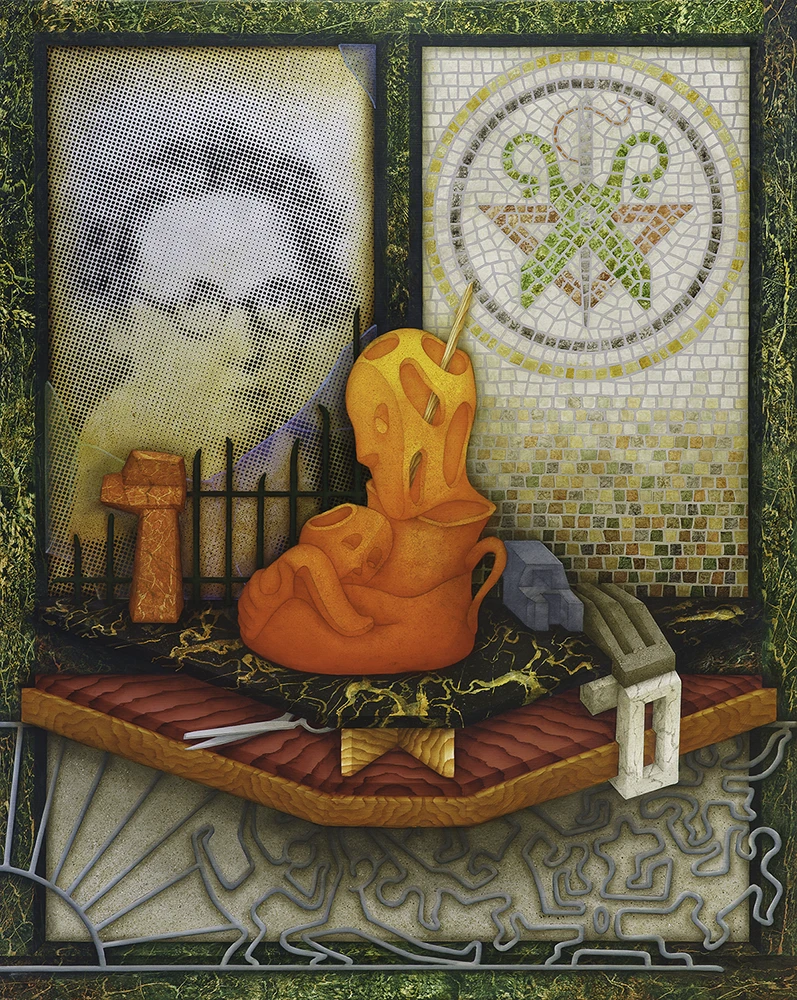
Marie Juchacz, Oil on canvas, 2025, 150 x 120 cm, courtesy the artist
About the artist and his work:
The portrait of Marie Juchacz is directly connected to David Czupryn’s personal life. Marie Juchacz became a politician of the workers’ movement and a member of the SoPaDe (today’s SPD). In 1919 she was the first woman to deliver a speech in the Reichstag (the German parliament). She herself came from a working-class background, worked as a garment worker, was divorced and a single mother, lived in exile, and later became both a politician and the founder of the AWO (the German Workers’ Welfare Association).
In the background of the painting, Juchacz’s portrait appears in a dot/grid structure. On the right, the guild emblem of the tailors can be seen. In the foreground stands a vase depicting a mother and child, with a pair of scissors placed between a sideboard and some architectural forms that spell out the letters AWO.
The personal link to David Czupryn is quickly explained: Marie Juchacz is one of his great idols in the history of German politics. He himself grew up in a working-class family, pursued his dream, and became an “academic” – what one might call upwardly mobile, a first-generation college student. At 18, while unemployed, he first came into contact with the AWO, where he prepared his applications that eventually led him to become a carpenter.
The broken window refers to the situation of the building at that time: the windows were always broken and never repaired, based on the idea that if they stayed broken, a thief wouldn’t bother to break in again. This, in away, echoed the phrase “there’s nothing to be gained here.” It also connects to another perspective on the “broken window theory,” which was the working title in the studio while the painting was being developed.